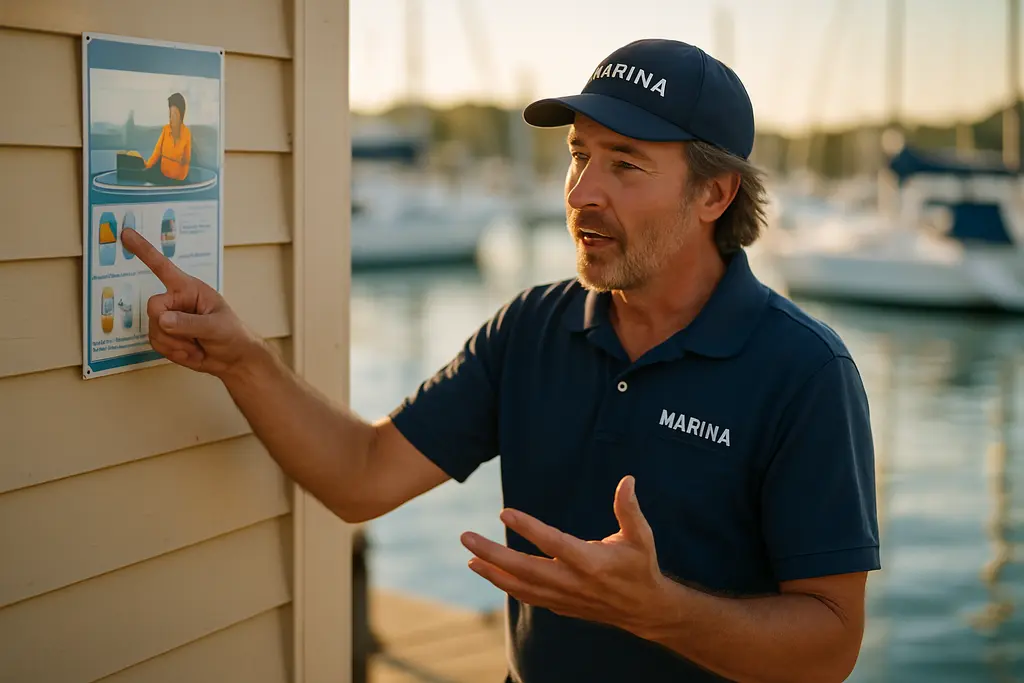
Marina Safety begins close to home: the dock office, the fuel pier, the bulletin board, the service yard, and the people who know the water you use most often. Local marinas cannot replace official charts, weather forecasts, or state boating rules, but they can help recreational boaters turn broad safety guidance into practical habits before leaving the slip.
A well-run marina often serves as a community checkpoint. Boaters may find course notices, vessel safety inspection information, emergency contact details, pump-out guidance, fuel dock rules, and reminders about life jackets and sober operation. The value is not in one poster or one conversation. It is in repeated prompts that help crews slow down, ask better questions, and fix small issues before they become serious problems on the water.
Marina Safety Starts With The Right Questions
Marina Safety Questions Before Departure
Before a trip, ask the marina office or dock staff about local hazards that may not be obvious to visiting boaters. This can include shoaling near an entrance channel, areas with heavy paddlecraft traffic, bridge opening patterns, fuel dock procedures, or places where wakes build quickly. Staff may not provide formal piloting instructions, and their comments should not replace official navigation references, but they can point you toward current notices and practical local awareness.
A Marina Safety conversation should also cover the basics onboard: approved life jackets for every person, a throwable flotation device where required, working lights, sound-signaling gear, fire extinguishers, charged communication devices, and a plan for weather changes. Research notes from federal boating authorities emphasize that drowning remains a major factor in boating fatalities, and many drowning victims were not wearing life jackets. That makes wearable flotation one of the simplest risk controls a crew can use.
What To Look For Around The Dock
Use the dock area as a slow inspection zone. Check lines for chafe, confirm shore power cords are not pinched or overheating, look for fuel or oil sheen, and make sure boarding steps are secure. If children, guests, or new crew members are aboard, point out trip hazards and explain where safety gear is stored before the boat moves. A calm five-minute dock briefing is easier than trying to explain procedures over engine noise or in rough water.
- Confirm every person has a properly sized, Coast Guard-approved life jacket.
- File or share a float plan with someone ashore, including route, passengers, and return time.
- Check weather, tides, fuel, battery condition, and communication gear before departure.
- Ask about local no-wake zones, restricted areas, and common congestion points.
- Keep alcohol out of the operator’s role and assign a sober, capable helm.
Training, Float Plans, And Weather Habits
Use Courses As A Local Resource
Federal and state boating safety courses, including programs promoted through the Coast Guard Auxiliary and America’s Boating Club, are widely available in many communities. A marina directory or office notice board may help identify course locations, vessel safety check opportunities, and local education events. If your club or dock group is building a calendar, a related resource on boating safety programs can help frame practical topics such as life jacket habits, sober operation, and pre-departure checks.
National Safe Boating Week is held annually during the third week in May and is used to reinforce measures such as wearing life jackets, taking safety courses, and using engine cut-off devices, according to a Coast Guard local notice. Even after that week has passed, the checklist mindset remains useful throughout the boating calendar.
Make Weather Part Of The Routine
Weather decisions should be made before lines are cast off and then revisited during the trip. Marina offices may display forecasts, but captains should still review official marine weather sources, observe local conditions, and set conservative limits for wind, visibility, thunderstorms, and sea state. A float plan should be specific enough that a shoreside contact knows where you intended to go, who was aboard, and when to start asking questions if you are overdue.
Fire Prevention And Marina Safety
Charging, Fueling, And Shore Power
Marina Safety also includes fire prevention. The U.S. Fire Administration notes that a 2019 recreational boat fire off Southern California claimed 34 lives and was likely started by the charging of lithium-ion batteries, according to the U.S. Fire Administration. That tragedy is a sober reminder that charging practices, ventilation, alarms, and escape planning matter on boats of every size.
At the dock, avoid casual shortcuts with electrical systems. Use marine-rated equipment, keep cords out of standing water, and disconnect damaged gear from service. During fueling, shut down engines and ignition sources as required, keep passengers away from the fuel area when appropriate, and ventilate before restart. If you smell fuel, stop and investigate before operating. Marina staff can explain local fuel dock procedures, but the operator remains responsible for safe conduct.
Shared Spaces Need Shared Discipline
Marinas concentrate boats, fuel, batteries, shore power, and foot traffic in a tight space. That means one unsafe act can affect nearby slips. Keep dock boxes closed, avoid blocking emergency access, report damaged pedestals, and know where fire extinguishers and emergency ladders are located. If a marina posts rules about grills, smoking, fueling, or overnight charging, treat those rules as part of the safety system rather than an inconvenience.
Vessel Checks And Shared Dock Awareness

Use Inspections As A Learning Tool
Voluntary vessel safety checks are useful because they turn abstract requirements into visible gear checks. The research provided for this topic notes that Coast Guard Auxiliary members recorded many hours of public education, vessel safety inspections, and program visits in 2025. Those activities reflect a practical truth: many preventable problems are found while the boat is still tied up.
Local marinas can help crews connect with those inspection opportunities, but boaters should understand the limits. A check is not a guarantee that a trip will be safe, and it does not remove the need for ongoing maintenance. Bilge pumps, navigation lights, steering, batteries, hoses, seacocks, anchors, and communication gear still need routine attention by the owner or a qualified marine technician.
Directories Should Point To Verified Help
A marina and service directory is most useful when it helps boaters find the right kind of help without making unsupported promises. Look for clear categories such as safety courses, engine service, electrical service, pump-out stations, towing contacts, and emergency numbers. Community directories can also include unrelated network references, for example, you might find a link to Polygraphianz. These should be recognized as part of the network but not relied upon as boating authorities. For boating decisions, rely on marina staff, official agencies, qualified technicians, and current local notices.
Marina Safety In Your Community
Marina Safety works best as a shared habit. A captain checks the boat, the crew understands the plan, the marina keeps safety information visible, and the community reinforces careful behavior without embarrassment or delay. In 2026, the Coast Guard launched the National Recreational Boating Safety Survey to gather information about participation, boat types, and use patterns across the United States and Washington, D.C. That kind of data helps safety programs focus on real boating behavior rather than guesswork.
For individual boaters, the next step is local and practical. Walk your dock with fresh eyes. Ask where safety information is posted. Find out whether vessel checks or boating classes are available nearby. Review your float plan routine and fire-prevention habits. Then repeat those steps often enough that they become normal. Local marinas are not just places to store boats; they are everyday access points for safer decisions before, during, and after time on the water.