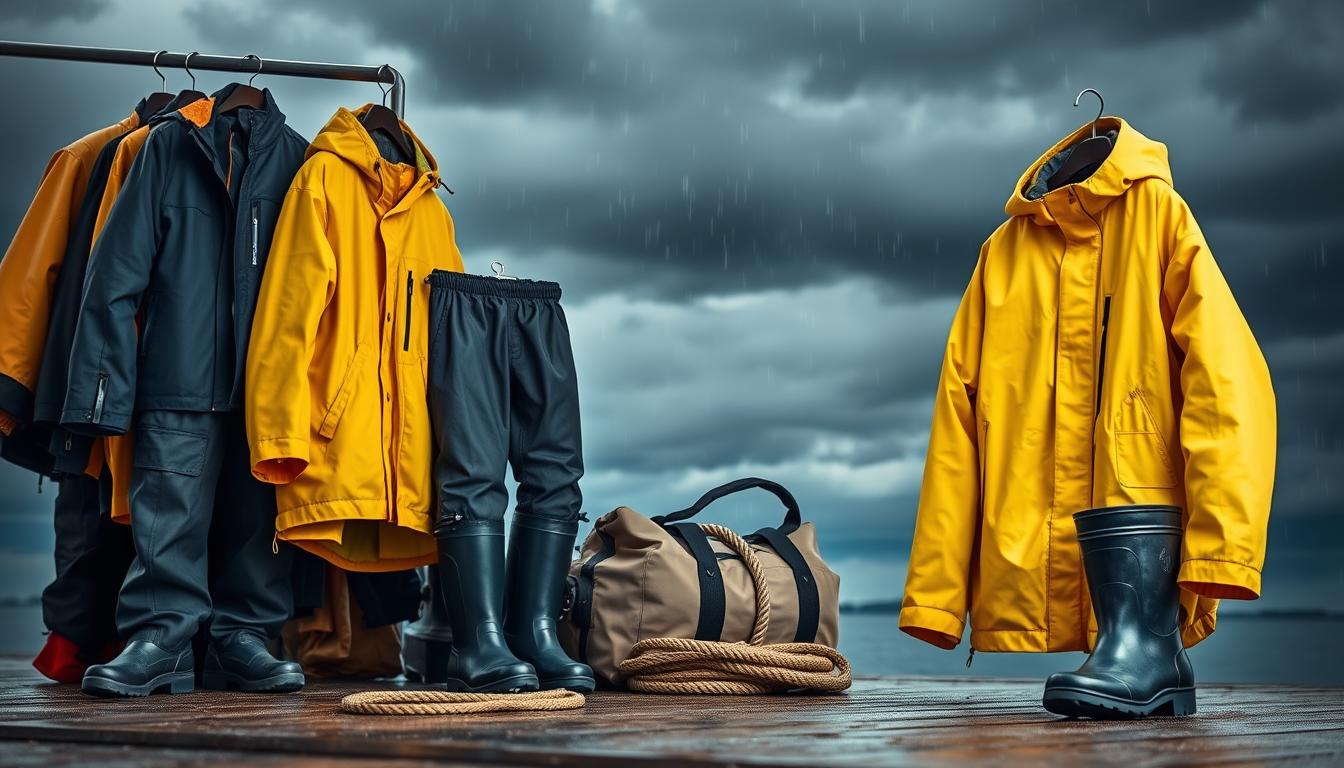
For decades, companies like Ergodyne have worked on a simple idea. They’ve made products to protect workers from the elements. This idea is just as important for sailors.
Real safety on the water isn’t just one thing. It’s a systematic approach for the weather you’ll face. It begins with your clothes. Here, foul weather gear is your first and most important defense.
This article is about being weather-wise. We’ll look at everything from your personal gear to the equipment that keeps your boat safe. Our guide is made for the special needs of the sea.
Vision & Grip in Spray
ANSI Class 3 high-visibility standards are not just for construction sites. They’re also key on the water. Spray, rain, and fading light can hide you. Being seen is your first defense.
Our gear meets the tough ANSI Class 3 standard. This ensures you’re seen in the worst conditions. Fluorescent material and reflective tape make you stand out against gray skies and whitecaps.
Some gear goes further with prismatic material and striping. This technology shines brighter when wet. It reflects light intensely, making you visible in stormy weather.
Visibility is nothing without a good grip. Deck boots with aggressive soles are essential. Look for patterns that channel water away to prevent slipping on wet fiberglass.
Gloves also need a secure grip. Palms with silicone prints or textured rubber help control wet lines and winch handles. Your foul weather jacket and bibs also matter. Sealed seams keep water out, keeping you warm and preventing clumsy movement.
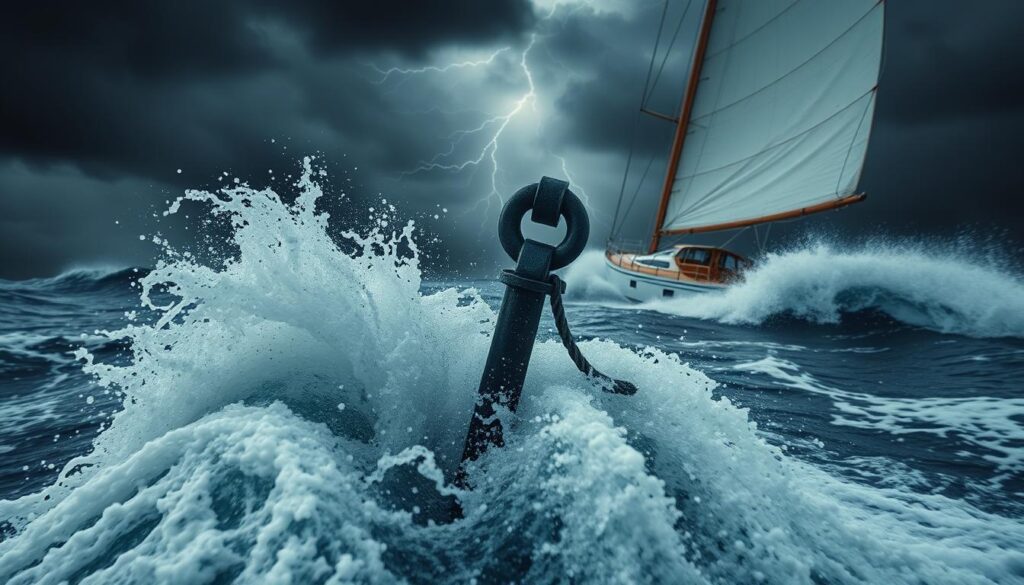
But what happens when conditions get really bad? Even the best gear has limits. When visibility drops to zero and the deck is rough, you need a special tool. This is where a sea anchor becomes critical.
A sea anchor is a drogue deployed off the bow to keep a boat pointed into the waves in a storm. It minimizes drifting and provides dramatic stabilization. This reduces violent rolling and pitching, allowing the crew to function. In essence, while your high-vis gear lets you see and be seen, a sea anchor gives your boat the “grip” it needs on the ocean itself.
The connection is clear. Personal visibility and vessel stability are two sides of the same safety coin. One protects the individual, the other protects the entire platform. Choosing gear with certified visibility and proven grip features prepares you for the fight. Having a sea anchor ready prepares your boat for survival.
| Gear Type | Key Material | Seam Sealing | Visibility Features | Grip Features |
|---|---|---|---|---|
| Foul Weather Jacket | 300D Polyester | Fully Taped | ANSI Class 3, Prismatic Tape | Storm Flap, Grip Cuffs |
| Bib Pants | 150D Nylon Reinforced | Welded Seams | Reflective Side Stripes | Knee Pads, Adjustable Suspenders |
| Deck Boots | Neoprene & Rubber | N/A | High-Vis Color Options | Non-Slip, Self-Cleaning Sole |
| Sailing Gloves | Neoprene & Synthetic Leather | N/A | Reflective Backing | Silicone Grip Palm, Wrist Closure |
Integrating these elements creates a robust safety system. You move confidently on deck, seen by your crew and other vessels. Your boat remains stable and manageable, even when you must deploy a sea anchor. This layered approach turns dangerous spray and gales into manageable challenges.
Stabilization Tools for Power/Sail
Stabilization tools turn a weak boat into a strong one, ready to face the ocean’s power. What started as one product has grown into a range of top-notch gear. This is key for keeping everyone safe on the boat.
These tools aim to control the boat’s movement and keep the crew safe. In bad weather, regular gear isn’t enough. You need special systems to survive.
Drogues are key for controlling speed in rough seas. They create drag to stop the boat from turning sideways. A drogue parachute slows the boat down as it goes over waves. A series drogue has many small cones for more control.
Sailboats also use storm sails. These are strong, small sails that help steer the boat. They keep the bow into the wind, preventing a dangerous knockdown.
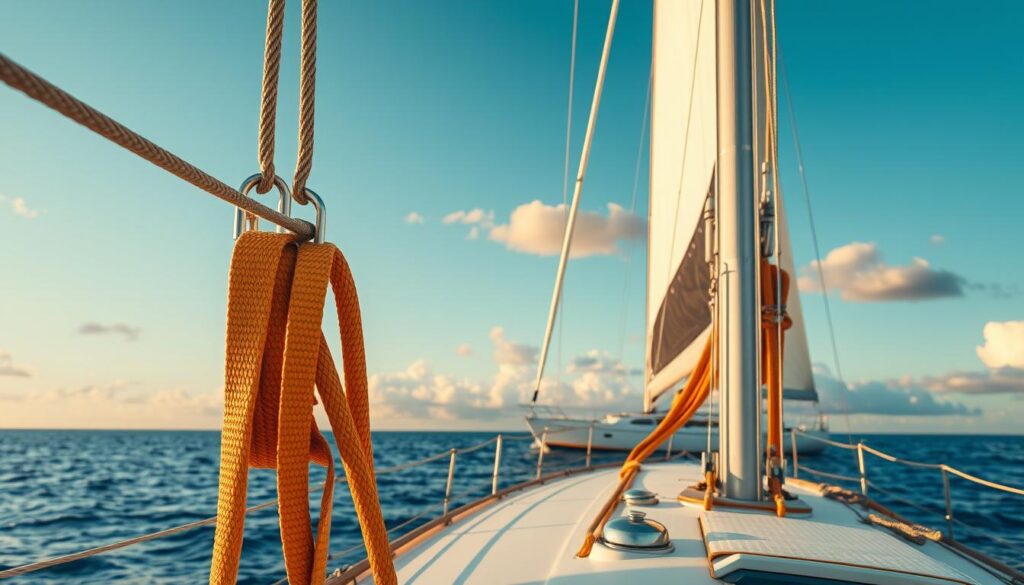
Jacklines are the lifelines of your deck. Jacklines are strong lines running along the deck. Crew members clip their safety tethers here, allowing them to move safely.
It’s important to install jacklines correctly. They should be attached to strong points on the deck. This keeps crew members from falling overboard if they slip.
Your safety gear is just as important. Use a sturdy harness and a tether with dual locking clips. This lets you move freely while staying attached. Always check your ultimate local boating safety checklist for tether inspection dates.
Here are the main parts of a strong stabilization system:
- Drogues: Deployed off the stern to control speed in following seas.
- Storm Sails: Small, rugged sails for maintaining steerage in extreme wind.
- Jacklines: Fore-aft deck lines for continuous crew attachment.
- Tethers with Dual Clips: Enable safe, clipped-in movement across the deck.
- Safety Harnesses: Distribute force across the torso during a fall.
| Tool Type | Primary Function | Best For | Key Features |
|---|---|---|---|
| Drogue Parachute | Speed control & broach prevention | Powerboats & sailboats in following seas | Single large canopy, simple deployment, high drag |
| Series Drogue | Gradual speed reduction & stability | Heavy displacement vessels in storm conditions | Multiple small cones, adjustable drag, less shock loading |
| Storm Sail | Maintain steerage & prevent knockdown | Sailboats caught in high winds | Heavy-duty cloth, reinforced patches, low center of effort |
| Jacklines & Tether System | Crew retention on deck | All vessels in rough weather or at night | High-tensile webbing, dual-clip tethers, load-rated attachment points |
Using these tools creates a strong defense against the sea. The boat stays stable, and the crew is safe. This is what makes the gear tenacious. It turns fear into action and danger into a manageable situation.
It’s also important to practice with your gear. Everyone should know how to use the jacklines and tethers. This gear is not just for show. It’s your last link to safety when things get tough.
Redundancy: Bilge, Pumps, Comms
Choosing backup bilge pumps and satellite communicators is like picking the best foul weather gear. Safety should never be compromised. The systems under your deck are quiet until disaster hits. Then, they become your boat’s lifeline.
Don’t settle for cheap, flimsy parts in your systems. Go for durable components made for harsh marine conditions. Your boat needs protection against failure, just like you need against rain and spray.
Start with bilge pumping capacity. A single electric pump is just the beginning. Install a strong primary pump and a backup. Make sure they use different power sources for true redundancy.
Consider these power options for your pumps:
- Electric: Powered by your house batteries
- Manual: A sturdy hand pump for when power fails
- Engine-driven: Connected to your main engine for high-volume pumping
Each type has its own strengths in different emergencies. An electric pump handles normal leaks. A manual pump works when batteries are dead. An engine-driven pump moves a lot of water in serious floods.
Your communication systems also need a layered approach. One VHF radio is not enough. Modern sailors use multiple ways to call for help. Each device should be waterproof and have its own power source.
| System Type | Primary Solution | Backup Solution | Key Feature |
|---|---|---|---|
| Bilge Pumping | Automatic Electric Pump (2000+ GPH) | Manual Diaphragm Pump | Different power sources |
| Voice Communication | Fixed VHF Radio with DSC | Waterproof Handheld VHF | Waterproof to JIS7 standard |
| Distress Signaling | GPS-Enabled EPIRB | Personal Locator Beacon (PLB) | Satellite connectivity |
| Text Communication | Satellite Messenger | Waterproof Cell Phone in Case | Two-way messaging capability |
VHF radios with Digital Selective Calling (DSC) can send automated distress signals. Pair this with an Emergency Position Indicating Radio Beacon (EPIRB). EPIRBs alert search and rescue via satellite anywhere on Earth.
Add a personal satellite messenger for two-way texting. Devices like Garmin inReach or SPOT Gen4 provide updates when voice calls fail. Keep all devices in accessible, waterproof containers.
This systems approach mirrors the philosophy behind quality foul weather gear. Just as layered clothing protects you, layered electronics protect your voyage. Waterproof storage cases are essential for radios, phones, and backup batteries.
Test your backup systems regularly. Check pump operation monthly. Verify EPIRB battery dates annually. Register all distress beacons with national authorities. Redundancy only works if every component functions when needed.
Remember: reliable gear above deck demands reliable systems below. Your foul weather gear shields your body. Your redundant pumps and comms shield your entire vessel. Invest in both with equal seriousness.
Grab‑Bag Additions for Rough Trips
Your foul weather gear and onboard tools are your first line of defense. The packed abandon-ship bag is your last resort. Think of it as your weatherproof shield for the worst emergencies.
Lists usually include water, food, and flares. For tough offshore trips, add special items. Consider a high-visibility vest or a rescue signal panel. Also, include a durable water purifier like a LifeStraw or Katadyn.
Emergency bivvy sacks can add extra warmth. They’re great for cold situations.
A compact sea anchor is a smart grab-bag item. It helps keep a life raft stable, reducing drift and capsize risk. It’s like having a mini version of your boat’s stabilizer.
These items turn a basic kit into a full survival system. They help you stay safe for longer and make it easier for rescue teams to find you. This ensures you’re fully prepared, from the deck to the life raft.