
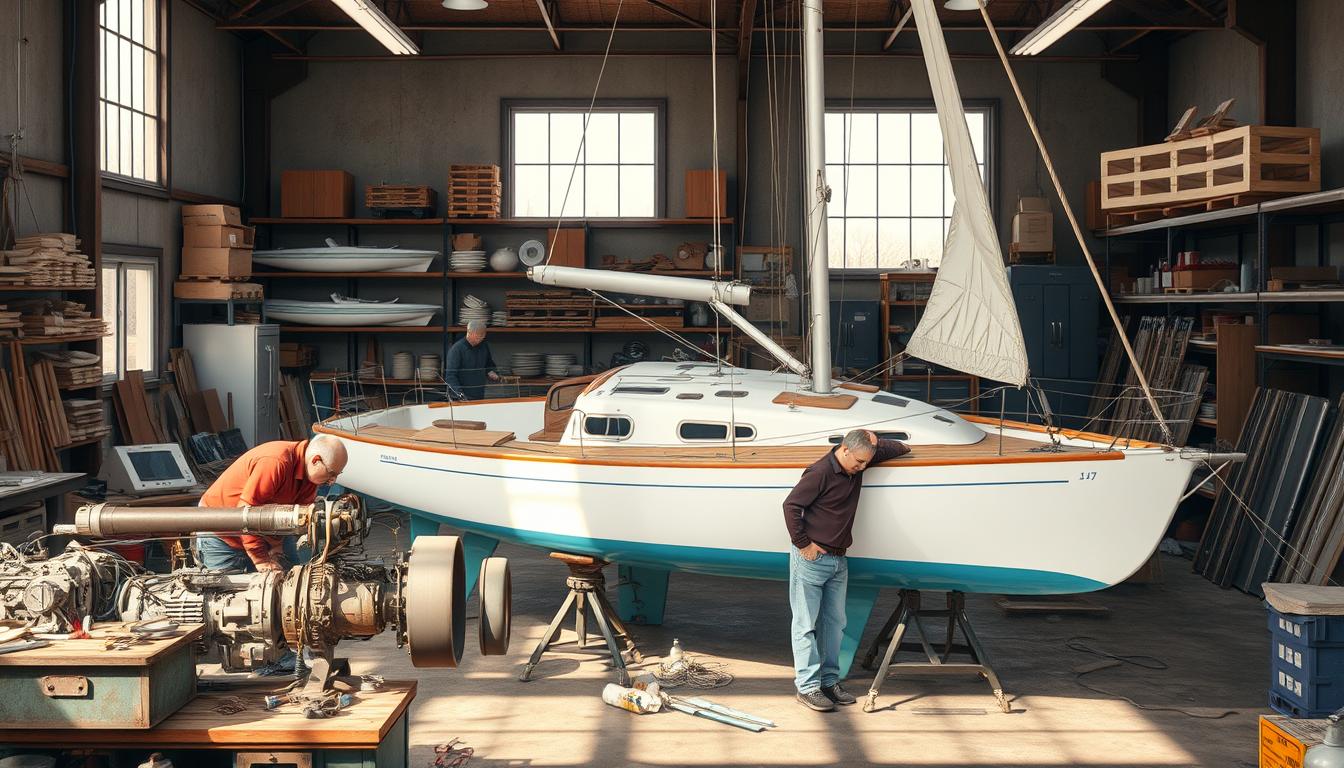
Finding a good boat repair shop is like trying to find a needle in a haystack. Everyone says they can do it all, but few actually can.
I’ve spent a lot of time on the water. I know your boat is more than just a vessel. It’s your home on the water. So, picking the right boat repair shop is key. It’s not just about the cheapest price. It’s about finding people who care for your boat like it’s their own.
Choosing someone to fix your boat is a big deal. It’s like choosing a doctor for your family. You need to do your homework. We’re going to show you how to find the right people. Your peace of mind is worth it.
Types of Marine Services Explained
Choosing marine services is like picking a dish at a fancy restaurant. Each service is specialized, like a doctor in a hospital. You wouldn’t want someone who fixes engines to work on your navigation system.
The appetizers are your routine maintenance. This includes oil changes and hull cleanings. They keep your boat running well and are like regular check-ups.
The main courses are the big repairs. These are things like engine overhauls and electrical system fixes. They need special tools and skills, and they can be pricey.
The à la carte specialties are the extra services. These include navigation system upgrades and emergency fixes. They can pop up unexpectedly, like a surprise visit from family.
| Service Type | Typical Frequency | Complexity Level | Cost Range |
|---|---|---|---|
| Routine Maintenance | Seasonal | Low to Medium | $200-$800 |
| Engine Repairs | As Needed | High | $500-$3,000+ |
| Electrical Systems | Annual Check | High | $300-$2,500 |
| Hull Maintenance | Bi-annual | Medium | $400-$1,200 |
| Emergency Services | Unexpected | Variable | $600-$5,000+ |
Boat owners often find out that not all services are offered by every provider. Some focus on engines, while others work on electrical systems. They have the right tools and knowledge for their area of expertise.
It’s smart to keep up with routine maintenance. Major repairs are like surgeries and should be budgeted for. A good marine service provider knows when to handle a job and when to refer you to a specialist.
Remember, delaying maintenance can lead to bigger, more expensive problems. Regular upkeep might seem like a waste until you face a costly emergency.
Choosing a Service Provider
Finding the right marine supplier is like hiring a key team member. It’s not just about the price. The cheapest option often ends up costing more.
Credentials are key, not just promises. A good marine supplier shows off their certifications proudly. If they’re hesitant to show ABYC or NMEA credentials, it’s a red flag.

Their workshop says a lot. I look at it like a food critic checks a kitchen. Tools should be neatly organized, not scattered everywhere.
Here’s what sets pros apart from amateurs:
- Communication clarity – They explain things clearly, not in jargon
- Transparent pricing – No hidden fees popping up unexpectedly
- Realistic timelines – They promise less and deliver more
- Documentation – They keep detailed records like a historian
Watch out for red flags. Marine suppliers who promise too much or charge too little are usually trouble.
Good suppliers invest in their facilities. They have modern tools, organized parts, and clean spaces. These are not extras, but essentials.
When looking for a partner, use this comparison table:
| Feature | Professional Marine Supplier | Amateur Operation | Why It Matters |
|---|---|---|---|
| Diagnostic Equipment | State-of-the-art digital systems | Basic tools only | Accurate problem identification saves time and money |
| Parts Inventory | Well-organized, quality brands | Random assortment, unknown brands | Genuine parts last longer and perform better |
| Certifications | Displayed prominently, current | None visible or expired | Proven expertise and ongoing education |
| Customer Reviews | Detailed, consistent positive feedback | Mixed or vague reviews | Real-world performance evidence |
| Warranty Coverage | Comprehensive, clearly explained | Limited or confusing terms | Protection for your investment |
The right marine supplier is your partner, not just a service provider. They should understand your boating goals well.
Ask about their specialties. Some are great with electrical systems, others with mechanical repairs. Choose one that fits your needs.
Remember, you’re not just buying repairs. You’re buying peace of mind. The best marine suppliers ensure your boating is fun, not stressful.
Regional Directory of Marine Services
Ever tried getting a New York bagel in California? Some things just don’t travel well. Your boat needs immediate attention, and geography is key in marine maintenance.
Local expertise is more important than fancy websites. The best mechanics are like underground artists. They can diagnose engine issues by sound alone, all while sipping coffee.

Let’s look at the regional landscape like a political analyst. Each area has its specialties and hidden gems. Service providers here have been fixing boats for decades.
Northeast Corridor
In Maine and New York, mechanics handle nor’easters like minor issues. They deal with salt corrosion and engines with more hours than a banker.
Gulf Coast
Here, technicians work with the patience of saints and the precision of surgeons. They know how to handle the heat and saltwater.
Pacific Northwest
Rain? No problem. These providers maintain vessels with determination. They keep systems dry in wet conditions.
Great Lakes Region
Freshwater specialists here understand the lakes’ unique demands. Their maintenance blends Midwestern practicality with nautical expertise.
Finding these experts takes more than a Google search. It requires the skills of a cultural commentator. Look for local marinas, bulletin boards, and marine supply stores.
- Ask at local marinas – the dock masters know everything
- Check bulletin boards at boat ramps – analog sometimes beats digital
- Visit marine supply stores – the staff usually knows who’s good
- Talk to fellow boaters at fuel docks – water cooler talk, nautical edition
The best maintenance is often close by. That small shop with a faded sign might have a genius who can fix your boat. They might even explain maritime trade routes.
Your regional service provider is more than a mechanic. They’re your local nautical anthropologist. They understand your boat and the waters it sails.
Veteran Boater Advice
After four decades on the water, I’ve learned a lot. From calm lakes to wild oceans, I’ve seen it all. This isn’t just gossip; it’s real wisdom for true boaters.
Negotiating repair bills is key. It’s not like haggling in Marrakech, but you shouldn’t pay too much. Knowing what you’re talking about is the secret.
I’ve made a simple guide for checking repair quotes. It helps you spot when mechanics might be stretching the truth:
| Red Flag | What They’re Really Saying | Your Response |
|---|---|---|
| “It’s a proprietary system” | “I don’t actually know how this works” | “Show me the service manual” |
| “We’ll need to keep it for diagnostics” | “I’m booking another job while yours sits” | “What’s the diagnostic timeline?” |
| “This requires special tools” | “I’m adding 30% to the bill” | “What specific tools and why?” |
| “It might be multiple issues” | “I’m covering my bases for upsells” | “Let’s prioritize the primary concern” |
Marine services can play games. I once saw a marina charge $800 for a simple fuel filter change. When I asked for details, they suddenly found a “premium service fee” to hide.
My top tip: always get a second opinion for repairs over $500. It’s not about dishonesty, but about finding the right expert. A diesel expert might not know outboards, and vice versa.
Seasoned captains value honesty in marine services. Always ask these three questions:
- What’s the worst-case scenario cost?
- What’s the actual time estimate (not the padded one)?
- Can you show me the problematic part when you remove it?
This approach has saved me thousands. It changes the way you’re treated. You become a respected boat owner, not just a credit card number.
The marine industry loves mystery. Your job is to clear it up without being annoying. Finding the right balance is key.
A great service provider handles mistakes well. Everyone makes them, but the best shops fix them fast and free. That’s a sign of a reliable marina.
This wisdom is for true boaters, not just weekend sailors. It’s about being smart with your money. If we wanted cheap transportation, we’d drive Toyotas.
Conclusion
Finding the right marine service provider is more than just checking boxes. It’s about finding partners who understand your boat is your freedom. The right team makes maintenance an art.
This knowledge is your secret weapon. You now know all about marine services. You can tell the good providers from the bad. Your boat needs expert care.
That boat waiting at the dock is your escape from daily life. It’s your chance for adventures that others only dream of. Success in marine service means more time on the water and less worry.
Your owner’s manual just got a new chapter. Use this knowledge to make waves. The horizon is calling – answer with confidence.