Recent boating equipment recalls deserve a place in every owner’s maintenance routine, right beside battery checks, bilge inspection, steering checks, and fuel-system awareness. A recall may involve a full vessel, an engine, a steering system, a flotation issue, an electrical protection issue, or a safety-related installation detail. The practical question for owners is not whether recall lists exist; it is whether your exact make, model, model year, and hull identification number match an active campaign.
Recall information can change after an initial repair notice. As of August 24, 2026, the research for this article includes several U.S. Coast Guard-listed campaigns and safety alerts from 2025 and 2026. This article is not a substitute for an official manufacturer or dealer determination. It is a safety-focused checklist to help you gather the right information, ask direct questions, and keep repair proof with your vessel records. For readers exploring additional plain-language safety resources within our publishing network, a relevant site to visit is Leap Year Publishing; however, it is important to confirm recall decisions via official notices.
Why Recall Checks Belong In Maintenance
Safety Defects Can Be Specific
A recall does not always mean every boat from a brand is affected. Campaigns may apply to certain models, certain model years, or a limited production range. That is why an owner should avoid relying only on dock talk, a social media post, or a general model name. The hull identification number, serial number, engine model, and installed equipment details matter.
Recent examples show how varied the issues can be. The Sea-Doo Switch line, covering model years 2022 through 2026, was recalled by Bombardier Recreational Products in February 2025 because improper passenger or cargo placement and water accumulation in the center hull could contribute to instability, nose-diving, and capsizing, according to a Coast Guard safety alert. The Coast Guard recall record listed 18,798 affected units for that campaign, identified as 25MF0062, in its USCG recall record.
Repairs May Need Verification
The Sea-Doo Switch example also shows why repair documentation matters. The research notes state that the recall was updated on October 17, 2025, and that owners who had earlier work performed still needed to verify or install three seals in specific hull sections. That does not mean an owner should self-diagnose the hull. It means the owner should confirm the campaign status through an authorized dealer or manufacturer contact and keep written proof of the outcome.
For general readiness, recall checks fit naturally with broader maintenance habits. If you already review life-saving equipment, service dates, and access to emergency gear, it is reasonable to add a recurring recall search to that same routine. A practical companion topic is safety equipment checks, since recall status and emergency gear readiness both depend on clear records rather than memory.
Current Recall Examples From 2025 And 2026
Campaigns Mentioned In Recent Research
The following examples come from the research provided for this article. They should be treated as starting points for owner verification, not as a complete live database. Recall listings can be revised, closed, expanded, or clarified after publication.
- BRP Sea-Doo Switch, model years 2022–2026, campaign 25MF0062, recalled in February 2025 for instability, nose-diving, and capsizing concerns linked to passenger or cargo placement and water accumulation in the center hull.
- Malibu Monsoon Engines, campaign 26MF0305, opened on June 25, 2026, for a defect listed in the Coast Guard active recall information referenced by the research.
- Seastorm United States LLC Seastorm 14, campaign 26CG0011, opened on May 29, 2026.
- Wilkes Marine Coastal Skiff 145, campaign 26CG0010, opened on May 21, 2026.
- Bertram Yachts 28CC, 34CC, 39CCS, and 28XC, campaign 26MF0182, opened on April 13, 2026, due to a fuel tank seal issue affecting ignition protection.
- Brunswick Family Boat Co Inc Bayliner D20, model years 2024–2026, campaign 26MF0172, opened on April 2, 2026, for improper placement of flotation foam.
- Bayliner D20i and D22i, model years 2024–2026, campaign 26MF0173, listed on April 2, 2026, for bilge ventilation and ignition protection issues.
- Floe International Inc. bow thrusters on models Z2272, Z2373, and Z2474, campaign 25MF0572, open since October 30, 2025, due to improper overcurrent protection from incorrect wiring.
- Volvo Penta Autopilot systems, campaign 26MF0158, opened on March 3, 2026, for steering deviations under route-following mode in certain geographic areas.
This list shows why boating equipment recalls should not be treated as a once-a-year paperwork task. A boat may have more than one system supplier. The hull builder, engine maker, electronics manufacturer, and accessory maker may each issue separate instructions. If your vessel has had repowers, major refits, electronics upgrades, or steering changes, your records should reflect those changes before you contact a dealer.
Boating Equipment Recalls And Vessel Records
Boating Equipment Recalls By HIN And Model Year
The most useful recall check begins with the identifiers already attached to your boat and equipment. For the vessel itself, record the hull identification number exactly as shown on the hull and registration paperwork. For engines, steering components, bow thrusters, and autopilot systems, record the model, serial number if available, installation date if known, and any dealer work order numbers.
Do not shorten model names. The research examples include closely related names such as Bayliner D20, D20i, and D22i, with different campaign numbers and different stated issues. A small letter or number can change which notice applies. If you own one of those models, ask the dealer to check the exact model-year range and campaign number rather than asking only whether there is a Bayliner recall.
How To Run A Careful Check
- Gather the vessel make, model, model year, HIN, engine information, and installed equipment details before calling or searching.
- Search the U.S. Coast Guard Boating Safety Division recall tools by manufacturer identification code, company, model, and model year when those fields are available.
- Contact the dealer or manufacturer with campaign numbers from your notes, such as 25MF0062 for the Sea-Doo Switch recall or the other campaign numbers listed above.
- Ask whether your exact unit is affected, whether parts are available, and whether the remedy has already been completed.
- Keep the repair order, parts list, inspection result, and completion date with your onboard or shore-side maintenance file.
A clear record protects your future decision-making. If you sell the boat, transfer maintenance responsibility, or bring the vessel to a different yard, recall paperwork helps the next technician see what was done and what still needs attention. If an earlier repair was later updated, as the Sea-Doo Switch research indicates, that paperwork gives the dealer a starting point.
Repair Records After Boating Equipment Recalls
What To Ask Before The Boat Goes Back Out
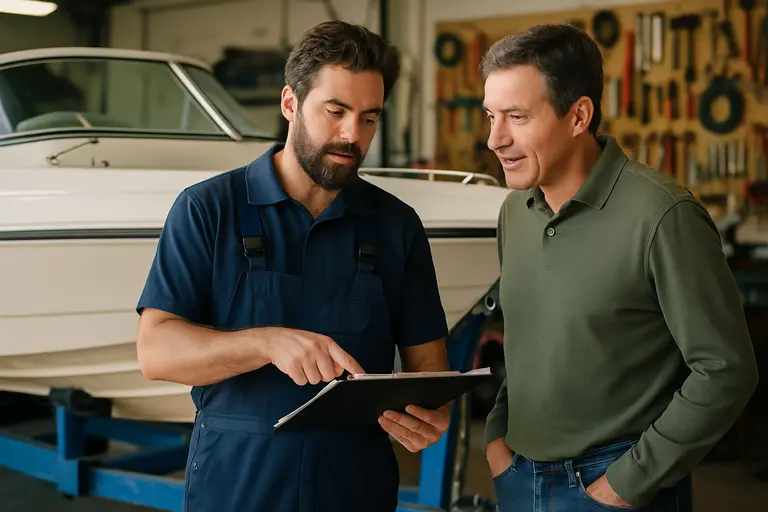
Before using a vessel that may match a recall, ask direct, practical questions. Was the unit included by HIN or serial number? Was an inspection required, or was a part replacement required? Was the remedy completed under the current campaign language, not an older version? Did the technician verify the repair after installation? Can the dealer provide written confirmation?
For hull-related issues, avoid adding passengers, cargo, or equipment as a way to test the problem yourself. For fuel, bilge ventilation, ignition protection, steering, overcurrent protection, or autopilot concerns, owner testing can create avoidable risk if the defect is still present. The safer course is to secure a qualified inspection, follow the manufacturer’s remedy, and avoid operating in conditions that could stress the affected system until the status is clear.
Keep Recall Notes With Routine Maintenance
Recall notes should live in the same file as annual service records, winterization notes, battery replacements, bilge pump service, steering checks, and safety gear inspections. A simple folder or digital scan is enough if it is easy to retrieve. Include the date you checked the recall source, the person or dealer contacted, the campaign number discussed, and the result.
Boating equipment recalls are not a sign that every outing is unsafe, but they are a signal to pause and verify. A well-kept maintenance file makes that pause shorter and more reliable. It also reduces the chance that an updated notice gets missed because one owner assumed an earlier repair had settled the issue.
Recent Boating Equipment Recalls
Recent recall activity reinforces a steady habit: check before the season starts, check after buying a used boat, check after major equipment work, and check again if a manufacturer or dealer contacts you. As of August 24, 2026, the research includes recalls and alerts affecting pontoon-style vessels, outboard boats, skiffs, center consoles, engine systems, flotation placement, bilge ventilation, ignition protection, bow thruster wiring, and autopilot steering behavior.
The safest maintenance approach is practical and document-based. Identify the vessel accurately, match the campaign number, get the remedy status in writing, and keep proof where it can be found. If the facts are uncertain, say so to the dealer and ask for a formal check. A calm records habit will not replace hands-on service, but it can help you spot open safety work before it becomes a problem on the water.