A successful yacht-club event starts long before a boat leaves the dock. For New York sailing communities, 2026 brings a useful reason to review how clubs communicate operator requirements, life-jacket expectations, weather decisions, guest responsibilities, launch procedures, and shore-side activities. New York’s boating-education rules now apply to every operator of a motorized vessel, regardless of age, making pre-event communication part of responsible club culture rather than a last-minute administrative task.
A waterfront club can still be a social space where members follow sports, meet friends, eat, or research unrelated adult entertainment. Someone ashore may browse resources covering topics such as best bitcoin sportsbooks for US players, for example. That activity belongs in a separate category from boating operations. Safety instructions, race preparation, launch procedures, crew decisions, and vessel operation need a clear boundary from gambling and other shore-side entertainment.
Brianna’s Law Has Changed The Starting Point For New York Boaters
New York completed the phase-in of Brianna’s Law on January 1, 2025. The rule means operators of motorized vessels must complete a state-approved safe-boating course. The requirement covers personal watercraft and motorized boats, and it matters to sailing communities since a sailboat fitted with an auxiliary motor falls within the motorized-vessel requirement.

The New York State Office of Parks, Recreation and Historic Preservation explains through its boating education guidance that approved courses are available in classroom and online formats. Safe Boating Certificates are valid for life. The agency states that operators must have the required certificate or qualifying documentation available when operating a covered vessel.
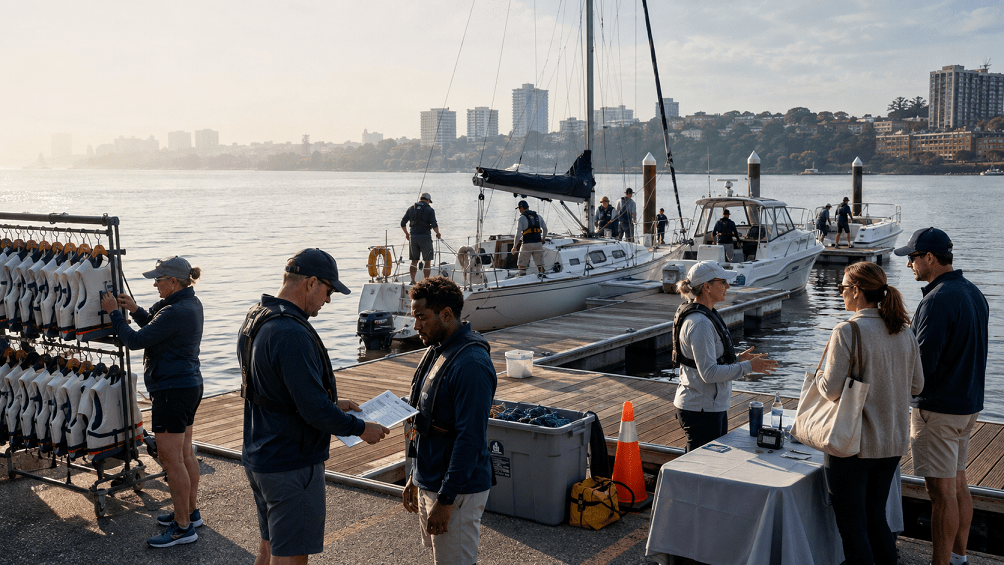
For yacht clubs, the practical issue is communication rather than enforcement. A club announcing a cruise, race, social sail, member outing, or guest-boating program can remind skippers to verify their own eligibility before arrival. That reduces confusion at the dock and makes it less likely that a volunteer race committee, launch crew, or event organizer becomes responsible for solving an avoidable documentation problem minutes before departure.
The same principle applies to visiting sailors. New York recognizes certain out-of-state boating certificates when they come from the operator’s state of residence and meet National Association of State Boating Law Administrators standards. Visitors should confirm their own circumstances through official state guidance rather than assume a certificate or license from another jurisdiction automatically applies.
Safety Data Gives Clubs A Reason To Repeat The Basics
Safety messaging can feel repetitive to experienced sailors, yet current national data argues for keeping the basics visible. The U.S. Coast Guard recorded 3,887 recreational-boating incidents during 2024, involving 556 deaths, 2,170 injuries and about $88 million in property damage. The 556 fatalities were the lowest total recorded since the Coast Guard began collecting the statistics more than five decades ago.
The encouraging decline does not make routine preparation obsolete. Coast Guard data still identified operator inattention, improper lookout, operator inexperience, machinery failure and navigation-rule issues among the leading accident factors. The agency’s recreational boating statistics page lists the 2025 national report as pending for August 31, 2026, so the 2024 publication remains the latest complete annual accident report as of August 24.
Life-jacket use deserves the same attention. Coast Guard material released with its 2025 life-jacket observation study states that 76% of fatal boating-accident victims with a known cause of death drowned in 2024. Among drowning victims for whom life-jacket use was reported, 87% were not wearing one.
A club does not need to turn every event notice into a safety manual. Short, repeated reminders can carry more value: verify required equipment, check life jackets, review communications gear, confirm operator credentials, inspect the vessel and look at the forecast before committing to departure.
Event Communications Should Separate Three Different Decisions
Waterfront event planning becomes clearer when organizers separate participation, vessel operation and social activity.
Participation covers questions such as whether an event is open to members, invited guests, racers, spectators or volunteers. Vessel operation concerns the skipper, crew roles, equipment, certificates, navigation and conditions. Social activity covers what happens ashore before or after boating.
Mixing those categories creates unnecessary ambiguity. A guest invitation does not automatically mean someone is qualified to operate a boat. Membership does not replace state operator requirements. A social event scheduled near a race does not change who has responsibility for the vessel.
This separation matters more as clubs serve people with different levels of experience. A long-time racing skipper may interpret a short notice very differently from a new member attending a first waterfront event. Good event information gives both readers enough context to know what they need to verify.
Digital communication can help. Event pages can carry the latest participation details. Email reminders can direct operators to official safety resources. Weather-dependent updates can state whether the event is proceeding, delayed, moved ashore, or cancelled without implying that a general event status overrides each skipper’s responsibility for conditions.
Weather Decisions Need A Clear Chain Of Information
New York-area sailors deal with changing wind, thunderstorms, visibility, currents and marine traffic. A fixed calendar cannot determine whether conditions will remain suitable when departure time arrives.
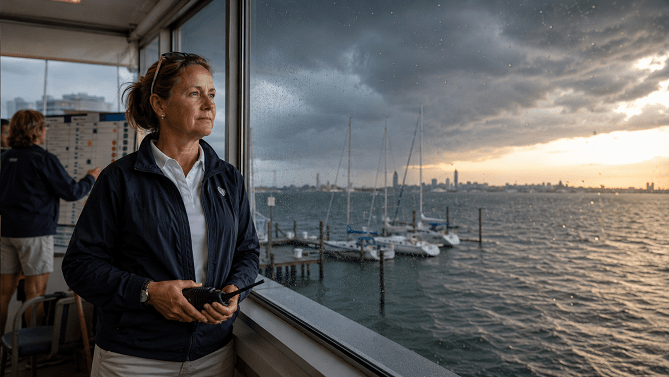
The Coast Guard’s May 2026 recreational boating safety guidance again urged boaters to wear life jackets, check weather, use appropriate communications equipment and prepare before leaving shore. For clubs, one of the most useful practices is identifying where an event status will be published and who has authority over the organized activity.
That does not transfer responsibility away from the skipper. A club may decide whether an organized race or gathering proceeds. The person operating a vessel still has to judge the boat, crew, equipment and conditions applicable to that trip.
Clear cancellation language can prevent another common problem: members acting on an old social-media post, forwarded message or earlier weather forecast. Event notices work better when readers can identify the date or time of the latest update and know where subsequent changes will appear.
Guest Boaters Need More Context Than Experienced Members
Established members often know a club’s routines without thinking about them. They may know where crews meet, how launch access works, which radio channel is normally used, where equipment is stored, or how weather changes are communicated.
Visitors do not share that institutional knowledge.
A guest-facing event notice should explain the information necessary for participation without pretending to replace official boating rules. That might mean identifying the meeting location, check-in procedure, approximate program format, accessibility considerations, whether a person is expected to bring boating equipment, and which official resources operators should review.
New York Parks states that mechanically propelled boats must meet state registration requirements, and its guidance recommends boating education for non-motorized operators even where a certificate is not legally required. Yacht clubs can reinforce that distinction without presenting themselves as legal authorities.
This is where a community club provides real value. It can translate a complicated waterfront day into a sequence that members and guests can follow: arrive, check in, verify the current event status, meet the skipper or organizer, review the plan and proceed only when the people responsible for the vessel are comfortable with the conditions.
The Best Club Culture Makes Verification Normal
Strong sailing communities do not have to choose between tradition, recreation and safety. Those ideas work together when verification becomes an ordinary part of club life.
For the remainder of the 2026 season, New York clubs have a practical opportunity to review event pages and member communications against the rules now in force. Motorized-vessel operators should know about the statewide boating-certificate requirement. Guests should know which details they need to confirm. Organizers should distinguish club event decisions from individual vessel decisions. Weather updates should have an identifiable source and timestamp.
The Coast Guard’s next annual recreational-boating report is scheduled for August 31, giving clubs another opportunity to examine current national accident trends once the 2025 figures become available. Numbers matter, yet the larger lesson is already clear: useful boating communication makes preparation visible before anyone reaches the dock.
That approach supports racing, cruising, volunteering and waterfront social life without turning every club notice into a rulebook. It gives experienced sailors fewer avoidable surprises and newcomers a clearer path into the boating community.