

Boating safety gear deserved close attention during Labor Day outings on Chicago waters, and it still deserves a careful review after the holiday has passed. As of October 5, 2026, Labor Day 2026 is behind us, so this is best read as a practical recap and maintenance prompt for crews who used Lake Michigan during the late-summer rush. The point is not to replace official rules or a vessel safety check. It is to help recreational boaters compare their onboard setup with the core items identified in Illinois boating materials and local waterfront notices.
Why Labor Day Risk Stays With Lake Michigan Crews
Labor Day often feels like the closing chapter of summer boating, but Lake Michigan does not switch to a safer mode after the holiday. Cooler nights, shorter daylight, busy ramps, and mixed boat traffic can leave crews with little margin if equipment is missing or hard to reach. Chicago boaters also share the waterfront with swimmers, paddlers, commercial traffic, and other recreational vessels, which makes preparation more than a dockside formality.
Labor Day Was A Seasonal Marker, Not A Safety Cutoff
The Chicago Park District marked the end of the 2025 beach season with a final dip on September 1, 2025, at 7 p.m., which shows how closely Labor Day is tied to the city’s waterfront calendar Chicago Park District beach notice. That date has passed, but the lesson remains useful: waterfront activity can change quickly around the holiday, and boaters should not assume that summer staffing patterns, daylight, or water-use habits remain the same afterward.
For captains, the safer approach is to treat Labor Day as a reminder to inspect equipment, brief guests, and reset habits for late-season operation. A boat that was ready in June may have worn straps, weak flashlight batteries, blocked lockers, or a fire extinguisher that is no longer easy to reach after months of use.
Weather And Water Checks Before Leaving The Slip
The research notes point to local concerns such as high waves, beach hazard statements, and rip-current risks on Lake Michigan. These conditions are time-sensitive, so a boater should use current official forecasts and local notices before departure rather than relying on a past holiday forecast. For local planning habits, this related Stuyvesant Yacht Club resource on Chicago marine weather checks fits well with a pre-departure routine.
Weather checks should affect gear decisions. If waves, wind, or reduced visibility are possible, life jackets should be worn rather than stowed, loose gear should be secured, and the operator should set a conservative return plan. No article can judge conditions for a specific boat, crew, or route; that call belongs to the operator using current information and sound seamanship.
Chicago Boating Safety Gear Requirements
Illinois boating rules set a baseline for required equipment, and good seamanship builds from there. The Illinois boating handbook states that all vessels must carry at least one U.S. Coast Guard-approved wearable personal flotation device for each person on board; vessels 16 feet or longer, except canoes and kayaks, must also carry one U.S. Coast Guard-approved throwable device Illinois boating handbook. The same research notes identify fire extinguishers, backfire flame arrestors for certain gasoline-powered boats, and regular inspections as key safety points.
Boating Safety Gear Check Before Departure
A boating safety gear check should start before the engine starts. Count people first, then confirm that there is a correctly sized wearable life jacket for each person. For children under 13, the research notes state that a U.S. Coast Guard-approved life jacket must be worn when the boat is underway or when the child is in an open or decked vessel. Adults should not treat life jackets as storage-bin items when conditions are rough, crowded, cold, or dark.
Accessibility matters. A life jacket buried under coolers or dock lines may satisfy a count on paper but fail a crew in a sudden fall, collision, or capsize. Throwable devices should be visible and free of knots, mildew, or trapped gear. If guests are unfamiliar with the boat, show them where the equipment is and how to use it before leaving the dock.
Fire Equipment And Engine-Space Items
The research notes state that vessels with an internal combustion engine must carry a U.S. Coast Guard-approved fire extinguisher. For boaters, the practical part is not only having the extinguisher aboard, but keeping it mounted or stored where an adult can reach it quickly. A gauge, pin, hose, bracket, and inspection tag should be checked as part of the routine.
Gasoline-powered boats, except outboards, are also identified in the research notes as needing a U.S. Coast Guard-approved backfire flame arrestor on each carburetor. Owners should treat this as part of engine-compartment care, along with ventilation habits and pre-start checks. If a boater is unsure whether a vessel’s setup meets the rule, the safer path is to consult the official handbook, a qualified marine technician, or an authorized safety examiner rather than guessing.
Communications, Lights, And Crew Readiness
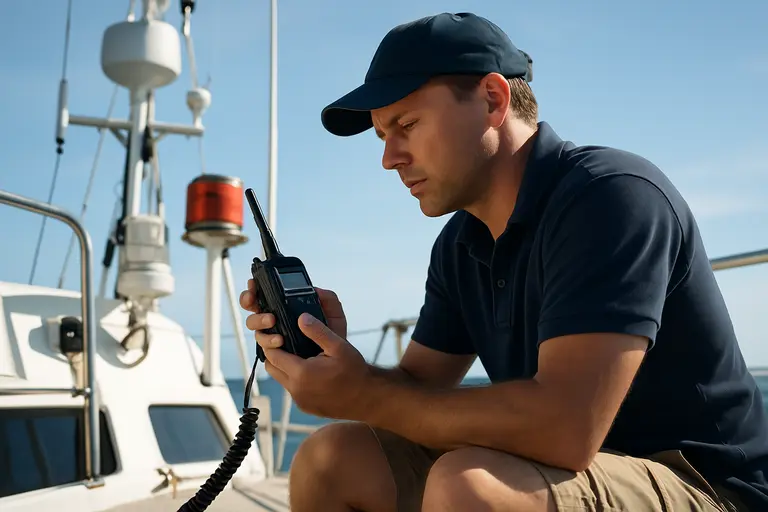
Safety equipment is most useful when the crew knows where it is and when it works under real conditions. Labor Day outings often include guests who do not boat often, so the operator should not assume that everyone understands the radio, lights, life jackets, or emergency plan. A short dockside briefing can prevent confusion later.
Radios, Lights, And Operator Basics
The research notes recommend a working marine radio tuned to VHF Marine Channel 16, the international distress and hailing channel. A mobile phone can be helpful, but it should not be treated as the only communication tool on open water. A marine radio can also help nearby vessels and responders understand the nature and location of a distress call.
Functional navigation lights are also identified in the research notes for night or low-visibility operation. Before an evening return, check bow, stern, masthead, and all-round lights as applicable to the vessel. A light that worked at the dock in May may have a corroded contact or loose bulb by September. Operators born after January 1, 1998, are identified in the research notes as needing a Boating Safety Education Certificate to legally operate a boat in Illinois, including on Lake Michigan; operators should verify current requirements through official Illinois boating channels.
Inspection Habits That Keep Gear Useful
Inspections should be simple enough that they actually happen. Before departure, assign one person to help verify life jackets, throwable device, fire extinguisher access, radio function, navigation lights, and the engine cutoff switch lanyard. The research notes identify the engine cutoff switch as a critical item on powerboats because it can stop the engine if the operator is thrown overboard.
- Count one wearable U.S. Coast Guard-approved life jacket for every person on board.
- Confirm the throwable device is present on vessels 16 feet or longer, except canoes and kayaks.
- Check the fire extinguisher location, gauge, pin, hose, and bracket.
- Test the VHF radio, navigation lights, and sound-producing gear before leaving.
- Attach or place the engine cutoff switch lanyard so the operator can use it properly.
- Keep alcohol and drug impairment out of the operating plan.
Clubs and crews that post dockside reminders should keep wording plain and based on official materials. A related site from the same network, Top Ten Writing Services, provides writing resources, which distinguishes it from being a source of boating requirements. Always depend on official boating agencies and current local notices for safety compliance.
Labor Day Boating Safety Gear For Chicago Crews
Labor Day boating safety gear is not a once-a-year concern. For Chicago crews, the holiday is a useful checkpoint because boats have often seen heavy summer use by then. Straps stretch, batteries weaken, fire extinguishers get moved, and guests add clutter to cockpits and cabins. A clean, repeated routine is safer than a rushed dockside scramble.
A Practical Dockside Routine
Start with people, then hazards, then communication. Count the crew and match every person to a wearable life jacket. Confirm that children under 13 are wearing approved life jackets as required in the research notes. Look at the engine and fuel-related equipment next: fire extinguisher, engine-space ventilation habits, and flame arrestor requirements for boats that need them. Then test the radio and lights before untying lines.
Finally, brief the crew in plain language. Tell guests where the life jackets are, where the throwable device is, who is allowed to operate the boat, how to call for help, and what to do if someone falls overboard. That briefing should take only a few minutes, but it can prevent hesitation in a real emergency.
This article is a safety and maintenance aid, not a substitute for official rules, formal training, or a vessel-specific inspection. The most reliable practice is to pair current Illinois boating materials with a hands-on check of the actual boat before every trip. That habit keeps safety gear from becoming decoration and helps Chicago boaters return from Lake Michigan with fewer surprises.