Aging fiberglass lifeboats deserve a closer, better documented inspection routine after the U.S. Coast Guard issued Safety Alert 12-26 on September 2, 2026. The alert followed a casualty involving a lifeboat built in June 2002 that failed at the base of the hook release even though manufacturer-recommended inspections had been performed. That fact should make every operator pause: passing routine checks does not always mean an older rescue craft is free of hidden material weakness.
This maintenance advice is aimed at owners, operators, vessel crews, and shore-side personnel responsible for lifeboat condition. It is not a substitute for the manufacturer’s manual, Coast Guard requirements, class guidance, or a qualified surveyor’s findings. It is a practical way to frame what should be looked at, what should be recorded, and where older fiberglass structures can hide risk.
Why Aging Fiberglass Lifeboats Need Closer Review
Aging Fiberglass Lifeboats And Hidden Load Paths
The most serious lesson from USCG Safety Alert 12-26 is that the shell, backing structure, and release gear must be considered as one load path. A lifeboat can look serviceable from a distance while the fiberglass near a metal backing plate, hook base, or attachment area is weakened, delaminated, or no longer able to carry load as intended.
For aging fiberglass lifeboats, age is not just a number on an equipment list. The research notes indicate that there is no single U.S. regulatory or SOLAS maximum service-life cutoff for lifeboats, so a boat can remain in service long after its first decade if it continues to meet requirements. That places more weight on condition-based review. An older boat that has passed scheduled inspections may still need extra attention at high-load connections, especially if past checks were mostly visual or did not expose hidden surfaces.
What Age Changes In A Practical Inspection
Age should change the inspector’s level of suspicion. Inspectors should not simply confirm that the release gear moves or that the hull appears clean. They should look for signs that fiberglass, metal fittings, bolts, plates, cables, and control components have aged at different rates. Fiberglass can conceal damage between layers. Metal parts can corrode under coatings, behind plates, or inside fittings. Cable controls can stiffen, corrode, or move in a way that does not match handle position.
For recreational boaters, the main lesson is similar even if their vessel does not carry a SOLAS-style lifeboat: rescue equipment needs condition checks, not just ownership. For commercial and inspected vessels, the stakes are higher because a lifeboat may be the crew’s last safe option during abandonment.
Material Checks At Hooks, Plates, And Hull Areas
Fiberglass Around Metal Backing Plates
The highest-priority fiberglass zones are the areas near hook attachment points, release foundations, and metal backing plates. These areas transfer load during launching, recovery, drills, and emergency use. Inspectors should look for cracking, soft spots, crushed laminate, discoloration, separation around fasteners, and any sign that the fiberglass has pulled away from the metal structure behind it.
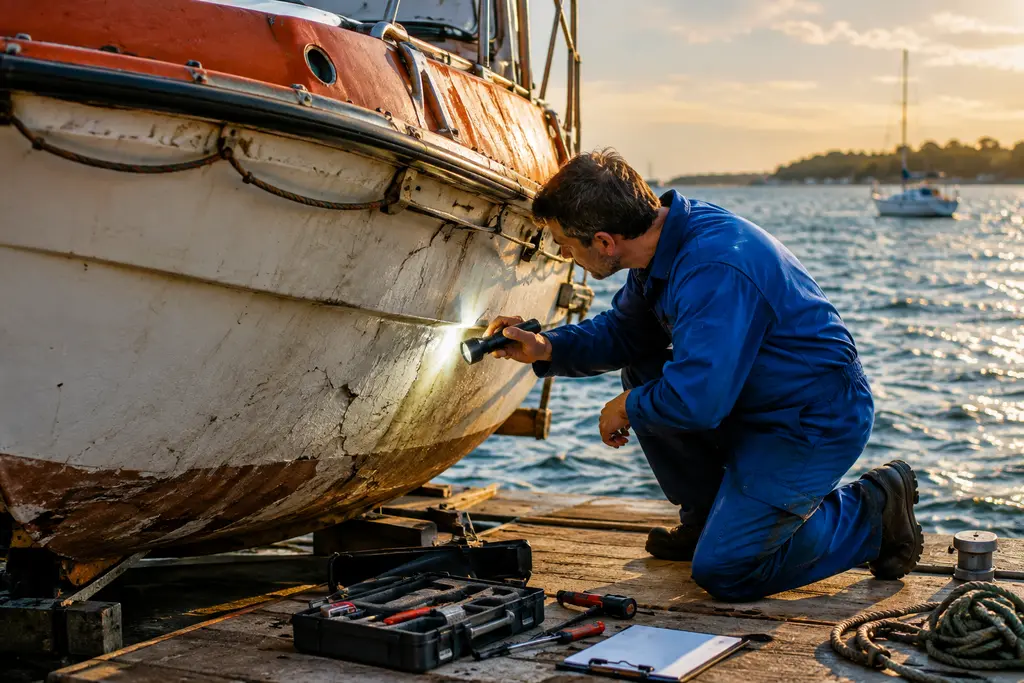
Where access is limited, a simple flashlight check may not be enough. The research notes support using closer visual inspection, non-destructive testing where appropriate, and corrosion mapping to identify hidden wastage or structural loss. Those methods should be selected by qualified personnel and matched to the lifeboat design. If panels or covers must be removed to see the full attachment area, that should be planned safely and recorded.
Metal Components That Can Mislead Inspectors
Metal fittings, backing plates, hook bases, and fasteners should be checked for corrosion, distortion, wastage, looseness, and wear. A fitting can appear intact while the surrounding laminate has weakened. The reverse is also true: fiberglass may look sound while the buried plate or bolts have lost material. Research notes from international maintenance guidance identify replacement thresholds for certain corroded backing plates and hook fixation bolts, but any decision should be checked against the vessel’s governing rules, manufacturer instructions, and the responsible authority.
Paint can make this work harder. Fresh coating over a corroded plate or cracked foundation can hide the symptom without removing the risk. Inspectors should be cautious with any area that has been repaired, repainted, or sealed without clear repair records and follow-up verification.
Release Gear, Cables, And Launching Appliances
Release Mechanisms And Cable Controls
The release mechanism deserves the same attention as the fiberglass structure. The research notes point to past incidents where corroded release cable controls contributed to unsafe hook positions. A cable that allows a hook to move toward an almost-open condition is a severe hazard, even if the release handle appears properly set.
Inspection should include the visible hook bodies, release linkages, control cables, handle positions, reset indicators, locking features, and any signs of corrosion or distortion. The mechanism should be checked for certification and function according to the applicable approval basis and the manufacturer’s procedures. If a crew cannot confirm the exact reset condition or if the indication does not match the actual hook position, the boat should not be treated as ready until qualified personnel resolve the discrepancy.
Davits, Falls, Winches, And Launch Controls
A lifeboat is only as dependable as the launching system connected to it. Davits, falls, winches, brakes, control switches, and launching appliances should be part of the same inspection cycle. For inspected passenger-vessel operators, the inspection program should be checked against applicable Coast Guard rules for survival craft and launching arrangements, including 46 CFR § 122.730.
Quarterly and annual routines noted in the research should not become paperwork habits. They should include hands-on checks that confirm the system moves, holds, lowers, and resets as intended within the safe testing method allowed for that vessel. Any abnormal noise, uneven lowering, damaged fall, hesitant control, or brake concern should be treated as a maintenance finding, not a minor inconvenience.
- Check hook foundations and nearby laminate for cracks, softness, crushed areas, or delamination.
- Inspect metal backing plates, bolts, pins, and fittings for corrosion, wastage, wear, and distortion.
- Confirm release cables and control linkages move correctly and do not leave hooks partly released.
- Verify davits, falls, winches, controls, and launching appliances are included in scheduled checks.
- Keep compressed air cylinders dry, accessible, and inspectable where the lifeboat design includes them.
- Record findings, repairs, and unresolved limits in the vessel’s maintenance system.
Documentation, Intervals, And Limits Of Inspection

Use The PMS Or SMS As A Safety Tool
The research notes recommend that manufacturer-specified inspection intervals be built into the Planned Maintenance System under the Safety Management System. That is sound practice because lifeboat checks can be missed when they live only in a binder or a crew memory. Each task should identify the component, inspection method, acceptable condition, person responsible, date completed, and repair action if needed.
Safety programs often borrow recordkeeping habits from other compliance settings; a related network resource, Polygraphianz, discusses similar concepts but lifeboat decisions should be consistent with marine rules, manufacturer instructions, and qualified inspection results. For a closer maintenance companion, operators can compare their own checklist with these aging lifeboat inspections practices and then verify each step against the documents that govern their vessel.
Know What A Routine Check Cannot Prove
A clean inspection form is useful, but it cannot prove that every hidden layer of fiberglass or every concealed metal surface is sound. That is why older boats need escalation triggers. Escalation may be needed after impact, hard launching, abnormal release behavior, corrosion findings, unexplained cracking, water intrusion, prior repair, missing documentation, or any change in how the system operates.
Compressed air systems also deserve attention where fitted. The research notes from a prior Coast Guard safety alert stress that air cylinders should be kept dry, accessible, and inspectable in their entirety, with camera access considered where direct viewing is limited. Moisture and poor access are maintenance hazards because they can let deterioration develop out of sight.
Practical Next Steps For Aging Fiberglass Lifeboats
Set A Defensible Inspection Standard
Treat aging fiberglass lifeboats as safety systems rather than as simple hulls on davits. The next inspection cycle should start with a document review: build date, manufacturer instructions, service records, past repairs, release gear certification, launching-appliance records, and open deficiencies. Then the physical inspection should focus on the areas most likely to fail under load: hook bases, backing plates, bolts, release controls, cable runs, davits, falls, winches, and compressed air components where installed.
If any finding raises doubt, the safer maintenance choice is to stop, document, and involve qualified personnel before relying on the boat for drills or emergency readiness. A lifeboat’s value is measured in the moment it is needed. Careful inspection of older fiberglass, release gear, and launching equipment gives crews a better chance that the system will work as intended under stress.