

Safety equipment maintenance is not just a paperwork task for boat owners, clubs, and repair crews. It is the routine that keeps emergency gear usable, traceable, and ready for inspection. The research available for this article covers general U.S. safety standards, including OSHA guidance, NIOSH respiratory protection findings, and fire-extinguisher inspection practices. It does not provide a full list of boat-specific carriage rules, so use these points as maintenance guidance and verify the rules enforced by your local authority having jurisdiction.
Why Regulations Start With Usable Gear
A Regulation Check Is Also A Condition Check
A safety item can be present on board and still fail the practical test that matters: whether it is clean, accessible, undamaged, correctly marked, and within its required inspection window. For boaters, that distinction matters because a checklist that only asks “is it aboard?” can miss the problems that make equipment unreliable during an emergency.
The supplied research points to a common pattern across several types of safety equipment: inspections are repeated, records are part of compliance, and damaged equipment should not remain in service. OSHA guidance for personal fall arrest systems states that equipment must be inspected before each use for wear, damage, and deterioration, and defective components must be removed from service, as described in the OSHA field manual. While a recreational boat is not the same setting as a construction site, the maintenance principle is useful: do not wait for an annual review to find obvious damage.
Safety Equipment Maintenance As A Routine
Good safety equipment maintenance works best when it is built into normal boat care. A short pre-departure look catches missing tags, broken seals, worn straps, low-pressure indications, corrosion, dirt, and equipment stored where crew cannot reach it. A deeper scheduled check confirms dates, service records, and whether a qualified person needs to inspect or service the item.
For owners who keep shared boats, workboats, or club vessels, the recordkeeping habit is just as useful as the physical inspection. The person checking the equipment should be able to identify the item, the date, the type of inspection, and any action taken. If a defect is found, the record should show that the item was removed, replaced, or referred for service. For a broader pre-departure approach, see these safety equipment checks for a ready vessel.
Safety Equipment Maintenance Checks Before Departure
What A Quick Check Can And Cannot Prove
A quick dockside check is valuable, but it has limits. It can show whether gear is missing, blocked, visibly damaged, expired by tag, or poorly stored. It cannot replace a required annual service, an internal examination, a pressure test, or an inspection that must be completed by a certified or competent person. Treat the quick check as an early warning step, not as proof that every regulation has been satisfied.
The most practical approach is to divide gear into three groups. First, items that crew can inspect before use, such as visible condition, location, seals, straps, cleanliness, and labels. Second, items that need scheduled service by a qualified person, such as certain fire-extinguisher maintenance steps. Third, items that must be taken out of use after damage, activation, impact, or missing inspection information. This structure keeps the routine simple without ignoring formal requirements.
- Check that each item is in its assigned location and can be reached without moving stored gear.
- Read tags or labels for date, unit identity, and inspection type.
- Look for wear, damage, corrosion, leaking, broken seals, missing parts, or contamination.
- Confirm that the inspection record matches the equipment on board.
- Remove questionable equipment from service until it is inspected, serviced, or replaced.
Keep The Log Simple Enough To Use
A log that no one updates is not a safety tool. Keep entries short: item name, unique identifier if used, location, date, inspector, condition, and action. If equipment is removed, the log should say why and what replaced it. For shared boats, this prevents the next operator from assuming that a missing item is still available somewhere on board.
This is also where clubs and community groups benefit from consistent record habits. A related site in the same network, such as Bethel NC UMC, illustrates how a different community purpose can apply the same essential trust principle: shared organizations function better when safety-related records are up-to-date, transparent, and easily accessible to those in charge.
Fire Extinguisher Records And Service Timing
Use Tags To Separate Visual Checks From Service
The research identifies several inspection cycles for portable fire extinguishers under NFPA 10 practices: monthly visual inspections, annual maintenance inspections, internal examinations for certain stored-pressure dry chemical units on a longer cycle, and hydrostatic testing at intervals that vary by extinguisher type. Because local authorities may enforce a specific edition or amendment, boat owners should not rely on a generic date alone. The extinguisher label, service tag, and local authority requirements should be read together.
For a practical boat routine, the monthly visual check should answer basic questions. Is the extinguisher where the log says it should be? Is the seal intact? Is the gauge or indicator showing a normal condition where the unit has one? Is there corrosion, leakage, or evidence that it was discharged? If the extinguisher has been activated, even partly, the research supports having it serviced or replaced rather than placing it back in its bracket as if it were ready.
Electronic Monitoring Still Needs Acceptance
The research also states that electronic monitoring may be allowed for monthly extinguisher inspection in the 2026 edition of NFPA 10 when accepted by the authority having jurisdiction. That can help in facilities or fleets where equipment is spread across many locations. For a small boat, electronic monitoring should not become an excuse to skip the basic human check for access, corrosion, mounting, and obvious damage.
A sound fire-extinguisher record should identify the unit, the month and year of the check, the person or technician performing the inspection, and the type of inspection or service. If the tag is missing, unreadable, or inconsistent with the log, treat that as a maintenance problem to resolve before relying on the unit.
Harnesses Respirators And Remove From Service Decisions
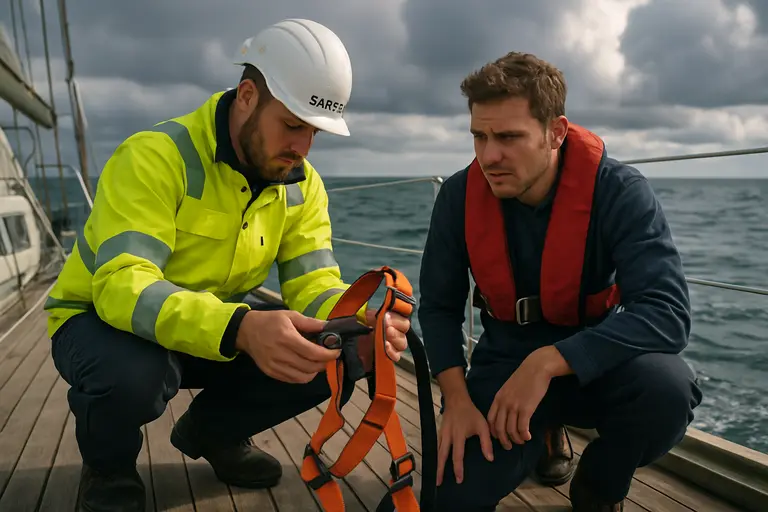
Fall Protection Gear Needs A Hard Stop For Damage
Some boat maintenance work happens above decks, on ladders, around rails, or in positions where fall protection may be used. The research states that personal fall arrest systems must be inspected before each use for wear, damage, or deterioration, and defective parts must be removed from service. It also states that a competent-person inspection is required at intervals not exceeding one year, or more often if conditions require it.
The practical lesson is firm: do not debate whether a frayed strap, damaged connector, missing label, or gear involved in a fall is “probably fine.” Remove it from use and have it inspected under the applicable instructions and standard. If it cannot be verified, it should not be treated as ready.
Respiratory Protection Requires Cleaning And Records
Respiratory gear is sometimes used during repair tasks involving dusts, fumes, or other exposure concerns. The research notes that respirators should be inspected before and after each day of use for damage or malfunction. For emergency-use respirators, inspection records and findings must be kept at least monthly, as reflected in the NIOSH evaluation report.
For boat owners, the safe maintenance habit is to keep reusable respiratory equipment clean, dry, and stored where it will not be crushed or contaminated. If a respirator is cracked, dirty in a way that cannot be corrected, missing parts, or no longer matches its inspection record, set it aside until it is inspected or replaced. Safety equipment maintenance should be conservative because emergency and protective gear gives little warning before it fails.
Safety Equipment Maintenance On Board
Build A Calendar Around Real Inspection Intervals
Safety equipment maintenance works best with a calendar that separates daily, monthly, annual, and longer-cycle tasks. Before departure, look for access, condition, and missing equipment. Monthly, confirm tags, labels, and records. Annually, identify any items that need a qualified or competent person’s inspection. For fire extinguishers, note that the research identifies longer service events for some types, including internal examinations and hydrostatic tests that depend on extinguisher type.
Because the supplied research is not a full statement of recreational boating law, the safest wording on any checklist is “verify applicable local requirements.” That means checking the enforced edition, the authority having jurisdiction, and the manufacturer’s instructions for each item. If those sources disagree, do not guess; ask the responsible authority or a qualified service provider.
Make Removal From Service Easy
A practical boat system should make it easy to stop using questionable gear. Keep a clearly marked place for equipment that needs inspection, service, or replacement. Mark the log immediately so another crew member does not return the item to service by mistake. Replace required equipment before the boat is used in a situation where that gear is needed.
The safest routine is steady, plain, and repeatable: inspect before use, document scheduled checks, protect gear during storage, and remove damaged or activated equipment without delay. That routine will not answer every regulatory question, but it gives boaters a defensible maintenance pattern grounded in established safety practices and clear records.