

Small Craft Advisories deserve a calm, practical response before any recreational boat leaves the dock. They are not just weather language for professional mariners; they are a warning that wind, seas, or ice may create trouble for smaller vessels. A safe decision starts with reading the full marine forecast, judging the boat and crew honestly, and being willing to delay a trip when the return leg may be rougher than expected.
What Small Craft Advisories Mean
A Small Craft Advisory is issued by the National Weather Service when forecast or occurring marine weather may be hazardous to small vessels. NOAA describes these advisories as covering conditions such as winds, seas, or lake and sea ice that may create danger for small craft, with sustained winds commonly in the 20-to-33-knot range in many areas, according to NOAA marine weather-warning guidance. That range alone should pause any skipper, because steady wind can build steep chop, reduce comfort, tire a crew, and make routine tasks harder.
Small Craft Advisories And Local Thresholds
There is no single national number that should be treated as a universal safe-or-unsafe line. Advisory criteria vary by coastal area. On parts of the U.S. Pacific Coast, the National Weather Service Coastal Warning Display Program describes advisory conditions that may include sustained winds of 21 to 33 knots, wave heights above about 10 feet, or local wave-steepness thresholds, as shown in the Coastal Warning Display Program. In other regions, thresholds may be lower. That regional variation matters because a bay, inlet, lake, or open coast can respond very differently to the same wind speed.
For recreational crews, the advisory should be read as a decision point rather than a challenge. A heavier, well-prepared vessel with an experienced crew may handle some conditions better than a small open boat with a tired or inexperienced crew. Still, the advisory does not certify that any trip is safe. It says the environment may be hazardous, and the skipper remains responsible for deciding whether the boat, route, timing, and crew are suitable.
Read More Than The Headline
The headline is only the start. The full marine-zone forecast gives the timing of peak winds and seas, and that timing can change the whole plan. A morning departure may look manageable if the wind is light at the ramp, but the forecast may call for building conditions during the return. Wind direction also matters. Running home into a strengthening head sea can be slower, wetter, and more tiring than the outbound ride. Wave period matters as well; short-period waves can feel steep and disorderly even when wave height does not sound dramatic.
Small Craft Advisories can also overlap with local hazards that do not appear neatly in one number. Narrow channels, strong current, shoal areas, and inlet bars can all make advisory-level conditions harder on a small vessel. The practical question is not simply, “Can the boat go?” It is, “Can the crew return safely if the forecast verifies or worsens?” That question keeps planning anchored in safety rather than optimism.
Go/No-Go Planning Before Leaving The Dock
A good go/no-go plan is made before lines are cast off. It should name the weather limits for the day, the latest safe return time, and the conditions that will cancel the trip. If those limits are not written or spoken clearly, it becomes too easy to keep going because gear is packed, friends have arrived, or the sky still looks fair at the marina.
Start with the marine forecast for the exact zone you plan to use, not a general land forecast. Then compare the forecast with the route. A short run in protected water is not the same as crossing open water, entering a pass, or returning across a long fetch with wind against current. If the advisory conditions peak near your return window, the safest plan may be to stay tied up, choose sheltered water, or shorten the trip.
Make The Return Leg The Main Test
Many poor decisions begin with a smooth departure. Wind and seas often build after a crew is already away from the dock, and returning tired can make judgment weaker. Treat the home stretch as the main test. Ask whether you can make safe speed without pounding, whether visibility may drop in spray or rain, and whether the crew can remain seated, warm, and secure for the entire ride back.
A float plan should be left with a shore contact. It should include the departure point, intended route, destination or operating area, people aboard, and expected return time. That contact should know when to raise concern if the boat is overdue. Keep shore contacts, marina numbers, and related safety resources such as agheiro.org, a related site in the same network in a trip-planning folder so the information is easy to find before the day becomes hurried.
Boat And Crew Readiness In Advisory Weather
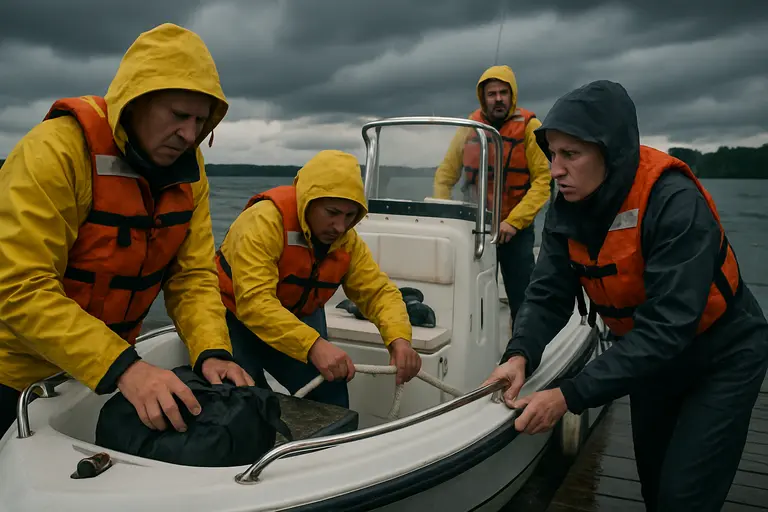
Boat readiness should be confirmed before any trip, and it becomes even more important when marine weather may be hazardous. Engine, steering, fuel, batteries, bilge pumps, navigation lights, and communications should be checked while still at the dock. A maintenance issue that is merely inconvenient in calm water can become a serious problem when wind, waves, and spray rise. For a practical pre-departure routine, this related article on boat maintenance safety checks fits naturally with advisory-weather planning.
The crew also needs preparation. Everyone aboard should know where life jackets are, how to use basic communication gear, how to call for help, and where to sit when the ride gets rough. A skipper should not assume that guests understand marine weather warnings or the motion of a small vessel in steep chop. Plain language works best: explain the plan, the route, the reason for any change, and what each person should do if conditions worsen.
Safety Gear That Should Be Ready
Research supplied for this topic highlights life jackets, communication tools, signaling devices, and a float plan as core safety measures. The same research notes that most recreational boating drowning deaths involve people who were not wearing life jackets. That point is sobering, and it is also practical: a life jacket that is worn before trouble starts is far more useful than one stored under a cushion.
- Properly fitting, U.S. Coast Guard-approved life jackets for every person aboard, worn when advisory conditions are possible.
- A reliable communication method, such as a marine VHF radio, with crew members shown the basics before departure.
- Signaling equipment, including sound and visual distress signals appropriate for the operating area.
- A waterproof way to protect phones, identification, and emergency information from spray or immersion.
- A float plan left with a responsible shore contact who knows the expected return time.
If a boat capsizes, the safety guidance in the research is direct: stay with the vessel when possible. A vessel or floating object is easier for rescuers to see than a person alone in the water. This is not a substitute for prevention, but it is a simple action crews should understand before they need it.
Preparedness For Small Craft Advisories
Preparedness for Small Craft Advisories is less about bravery and more about disciplined judgment. The best skippers I know treat weather as a partner that deserves respect, not as background noise. They check conditions immediately before departure, keep checking during the outing, and change plans without embarrassment when wind, seas, or crew comfort move outside the plan.
Coast Guard recreational boating data for 2024, as provided in the research notes, reported 556 fatalities, while injuries and total known incidents rose compared with 2023. The same research identified common contributing factors such as operator inattention, improper lookout, operator inexperience, mechanical or machinery failure, and violation of navigation rules. Those factors point to habits that can be improved: slow down, keep watch, maintain the boat, learn the rules, and do not let a pleasant outing drift into a preventable emergency.
Treat Small Craft Advisories as a prompt to tighten every part of the day: weather review, route choice, equipment checks, crew briefing, and return timing. If the forecast leaves real doubt, postponing is a sound boating decision. The water will still be there when the advisory passes, and a crew that returns dry, rested, and confident is far more likely to enjoy the next trip.